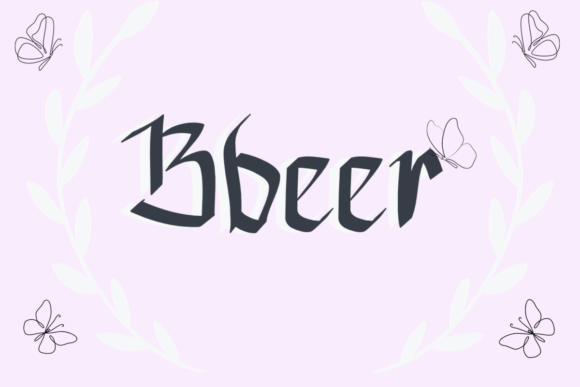
Bbeer Handwritten Font for Crafters & Sellers
As someone who designs printable invitations, cuts vinyl stickers for boutique shops, and prints custom labels for handmade candles and soaps, I’m always hunting for a script font that does more than just look pretty—it needs to work. That’s why Bbeer landed on my shortlist the moment I saw it: a warm, expressive handwritten font with grounded charm and quiet confidence. It’s not overly ornate or fragile—it’s got presence, rhythm, and just enough personality to carry your brand without shouting over your product.
Bbeer belongs to the Script Amp category, which tells you right away it’s built for impact—not subtlety. But unlike many display fonts that sacrifice legibility for flair, Bbeer balances both. Its strokes feel hand-drawn but consistent, with natural variation in line weight and gentle tapering that mimics real ink on paper. There’s no forced quirkiness here—just honest, approachable handwriting that reads clearly at 24pt on a greeting card and still holds up at 120pt on a farmhouse-style welcome sign.
I’ve used Bbeer across dozens of physical and digital products—and each time, it elevated the perceived quality. For candle labels? Yes. A small batch of lavender-scented soy candles needed something that whispered “artisan” without leaning into cliché calligraphy. Bbeer gave the label warmth and authenticity while staying crisp enough for laser printing. On sticker sheets for planners? Absolutely. Its lowercase ‘a’, ‘g’, and ‘y’ have open, friendly shapes—no tight loops or confusing joins that snag during die-cutting on my Cricut Maker.
Wedding stationery is where Bbeer really shines. Think rustic-chic welcome boards, foil-stamped menu cards, or printable RSVP postcards. It pairs beautifully with clean sans serifs like Montserrat or Poppins—use Bbeer for names and headings, then switch to the sans for addresses and details. That contrast creates hierarchy without clutter. And because Bbeer’s spacing feels intuitive (not cramped or overly loose), it flows naturally on curved paths—perfect for SVG-based wedding arch signs or circular jar labels.
For seasonal craft sellers, Bbeer adds instant storytelling. Halloween treat bags? Try “Hand-Poured Potion” in Bbeer above a simple cauldron icon. Holiday mugs? “Cozy & Brewed” works perfectly in Bbeer—friendly, slightly nostalgic, never cutesy. Even game-themed printables—like D&D character sheets or legend-inspired wall art—gain depth with Bbeer. Its subtle historical texture nods to parchment and quill without veering into fantasy overload. It doesn’t scream “medieval”—it whispers “timeless.”
Readability matters most when scaling down. I tested Bbeer on ¾-inch round stickers for soap bars: at 10pt, the uppercase letters held their shape well, and key words like “Oatmeal” or “Lavender” remained instantly scannable. For tiny tags on jewelry pouches, I stuck to single words or initials—Bbeer isn’t meant for paragraphs, and that’s okay. It’s a display font first, designed for titles, names, banners, and focal phrases. Use it where attention lands—not where information scrolls.
Font pairing is where Bbeer becomes even more versatile. With its soft, organic energy, it plays well alongside structured typefaces. Try it with a sturdy serif like Playfair Display for book covers or boutique packaging, or lean modern with Inter or Lato for social media graphics and digital downloads. Avoid pairing it with other scripts unless you’re intentionally layering textures—for example, Bbeer as a headline over a delicate brush script for secondary text. Less is more; let Bbeer breathe.
The Bbeer font includes standard OpenType features—ligatures, stylistic alternates, and basic swashes—so you can fine-tune how “History,” “Legend,” or “Game” appears across your product line. These aren’t gimmicks; they’re tools. The alternate ‘Q’ and ‘S’ add subtle distinction to shop signage. The optional swash on the capital ‘B’ makes for standout logo lockups on tote bags or enamel pins. And yes—it supports extended Latin characters, so if you sell internationally or design bilingual baby shower invites, you’ll find solid multilingual coverage.
File formats matter too. Bbeer comes in OTF and TTF, so whether you're importing into Silhouette Studio, Cricut Design Space, Canva, or Adobe Illustrator, you’ll get reliable rendering. No missing glyphs, no wonky kerning on mockups—and crucially, no surprises when your client opens your editable template and sees everything intact.
Licensing is non-negotiable for sellers. Bbeer is a commercial font, meaning you’re fully covered to use it in physical products (stickers, mugs, apparel), digital downloads (planner pages, invitation suites), SVG files for cutting machines, and even client work—no extra fees or attribution required. That peace of mind lets you focus on creating, not compliance. Just keep your license file handy—it’s part of your toolkit, like good scissors or quality vinyl.
If you’re curating fonts for your shop’s visual language, Bbeer fills a very specific, very useful role: the human voice behind your brand. Not the background music—the voice. It’s what makes a customer pause at your Etsy listing, tilt their head at your farmers’ market sign, or save your Instagram story because the wording felt personal. It’s not flashy—but it’s memorable. And in a crowded handmade marketplace, that kind of quiet resonance is gold.
Whether you're designing a limited-run zine, prepping holiday packaging for your herbal tea line, or building a cohesive set of digital templates for fellow creators, Bbeer delivers consistency without repetition. It adapts—never overwhelms. And best of all? It feels like yours the moment you type with it.